He Parked His Booze Past the Law: Bill McCoy and Rum Row
U.S. waters ended three miles offshore, so a Florida boatbuilder anchored at mile four and opened for business. The phrase named after him is older than he is.
- National Prohibition began on January 17, 1920, under the 18th Amendment and the Volstead Act.
- Bill McCoy, a boatbuilder from Holly Hill, Florida, cleared about $15,000 on his first liquor run, more than five years of boatbuilding pay.
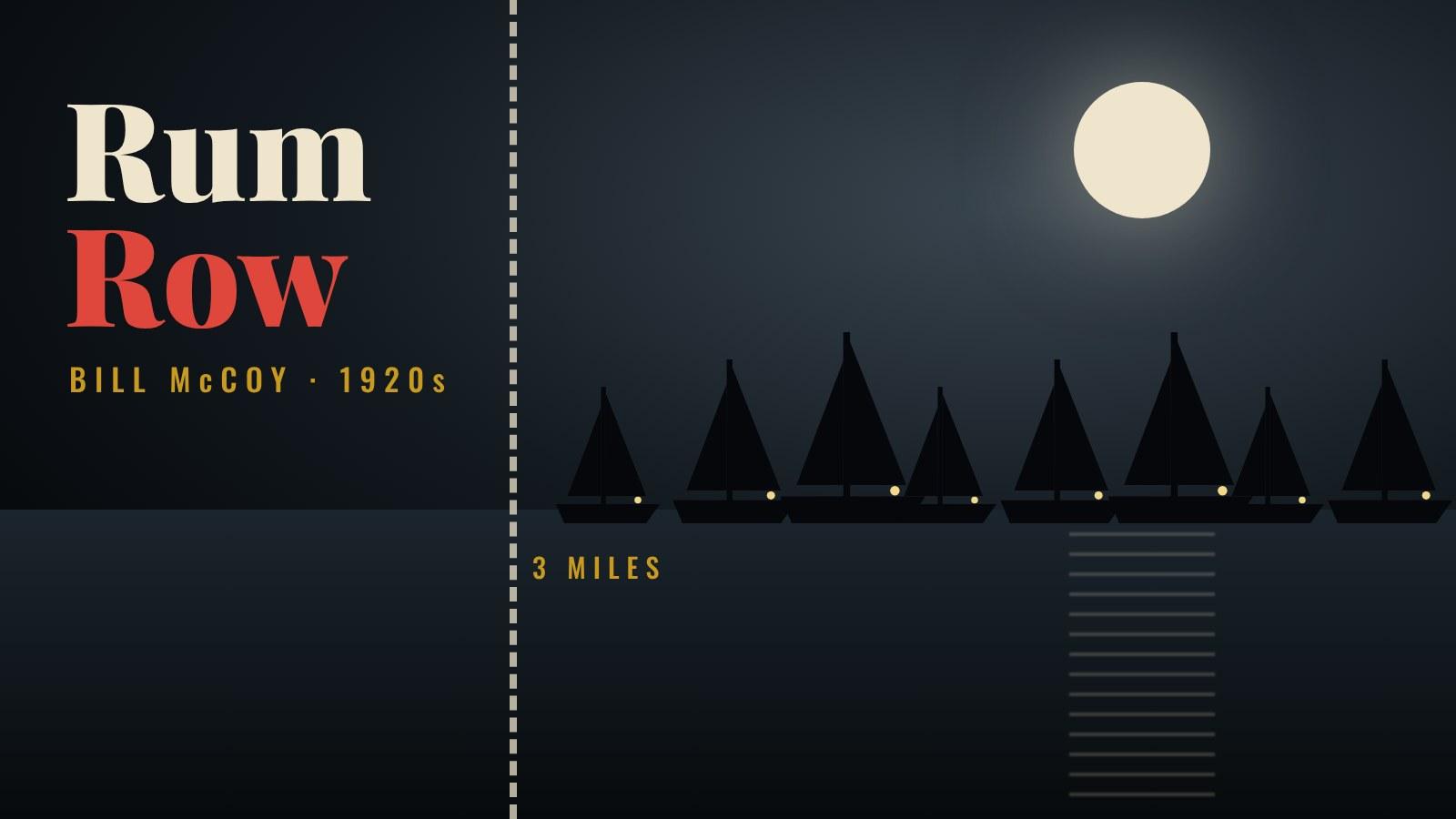
- U.S. waters then ended three miles offshore, so McCoy anchored just past the line and sold to buyers who came out in small boats. The line of ships that copied him became Rum Row.
- In November 1923 the Coast Guard cutter Seneca seized his schooner Tomoka about six miles off New Jersey. He later pleaded guilty and served nine months in a New Jersey jail.
- The phrase "the real McCoy" probably isn't about him. A Scottish version, "the real MacKay," was in print by 1856.
1 · A boatbuilder finds a better business
Bill McCoy built boats in Holly Hill, Florida. Then, on January 17, 1920, national Prohibition began. The 18th Amendment banned making, selling and moving liquor, and the Volstead Act, passed over President Wilson's veto, set the rules for enforcing it.
Americans didn't stop drinking. They just needed someone to bring it in. In 1921 McCoy bought the Henry L. Marshall, a 90-foot fishing schooner, in Gloucester, Massachusetts, for about $16,000. She could carry 1,500 wooden cases of liquor.
He loaded up with liquor from the Bahamas, where it was legal, and kept his ships under British registry so U.S. officers would have a harder time touching them. The first run cleared about $15,000. The Mariners' Museum puts that at more than he could have made in five years building boats.
One trip paid more than five years of honest work.
2 · Three miles out
McCoy's real idea was where he sold. U.S. waters ended three miles from shore. Past that line, a foreign-flagged ship was on the high seas. So he anchored just beyond it, off New Jersey and Long Island, and waited. Buyers ran out in fast small boats, paid, loaded up and raced back in.
Other ships copied him, and soon a whole line of them sat off the coast like a floating liquor district. People called it Rum Row.
McCoy's selling point was quality. By the accounts that survive, he didn't water down or cut what he sold, which was not something buyers could count on during Prohibition. He later bought a bigger schooner, the Arethusa, and renamed her Tomoka, after a river near his Florida hometown.
3 · The Seneca comes for the Tomoka
In November 1923 the Coast Guard cutter Seneca came for the Tomoka. Sources give the date as November 15 or November 23. The schooner was about six miles off New Jersey, past the three-mile line, and a boarding party from the Seneca took her anyway. Before the seizure, the State Department had gotten the British government to agree not to object if the British-registered Tomoka had to be chased down.
The case dragged on for well over a year. In March 1925 McCoy pleaded guilty, and he served nine months in a New Jersey jail. One account says he was allowed out during the day as long as he was back by 9 p.m.
One source says he walked out on Christmas Day 1925 and went home to Florida.
4 · The line moves
By then the rules on the water had changed. On January 23, 1924, the United States and Britain signed a treaty that let U.S. officers board British ships suspected of smuggling liquor within one hour's sailing distance of the coast. For a fast ship that worked out to roughly 12 miles, though British officials said the treaty didn't set any fixed number of miles. Rum Row had to move farther out, and the small boats had a much longer run in.
Prohibition itself ended on December 5, 1933, when the 21st Amendment was ratified. It's still the only amendment that repealed another one.
5 · So is he the real McCoy?
The legend says McCoy's honest liquor gave English the phrase "the real McCoy," meaning the genuine article. It's a great story, and it's probably wrong.
A Scottish version, "the real MacKay," was in print by 1856, decades before Prohibition. Other McCoys have been put forward too, including the inventor Elijah McCoy and the boxer Kid McCoy, but word historians say the phrase's true origin is unknown.
Bill McCoy died in Stuart, Florida, in 1948. So maybe he didn't invent the phrase. He just lived up to it.
Sources give different dates for a few events, including the day McCoy's schooner was seized. Where they differ, this story says so.
Sources
Every fact in this story was checked against these sources on Nov 28, 2026. Lines that start with "maybe" are just our own guesses.
- The Real McCoy, The Mariners' Museum and Park
- The Long Blue Line: Bootleggers beware, Prohibition law enforcement 100 years ago, U.S. Coast Guard History
- Smugglers, Bootleggers, and Scofflaws, National Archives, Prologue Magazine
- The Real McCoy, BoatUS Magazine
- End of the line for Bill McCoy, king of the rum runners, Monmouth Timeline
- William McCoy (rum runner), Wikipedia
- Prohibition in the Federal Courts: A Timeline, Federal Judicial Center
- Convention between the United States and Great Britain to aid in the prevention of liquor smuggling (1924), U.S. Department of State, Office of the Historian
- Ratification of the Twenty-First Amendment, Cornell Law School, Legal Information Institute
- Proclamation 5928: Territorial Sea of the United States, National Archives, Federal Register
- The Real McCoy, Snopes
- real McCoy, the, Word Origins
How we make our stories: researched and fact-checked by CoinNCountry, with AI tools helping with drafting, art and narration. More about our process.