Nvidia's CEO Quit, Then Came Back! The AI stock crash and the radio bubble of 1929
Jensen Huang resigned on November 12 and was reinstated on November 23. In between, AI stocks slid into a correction. The last hot tech stock to crash this hard was a radio company.
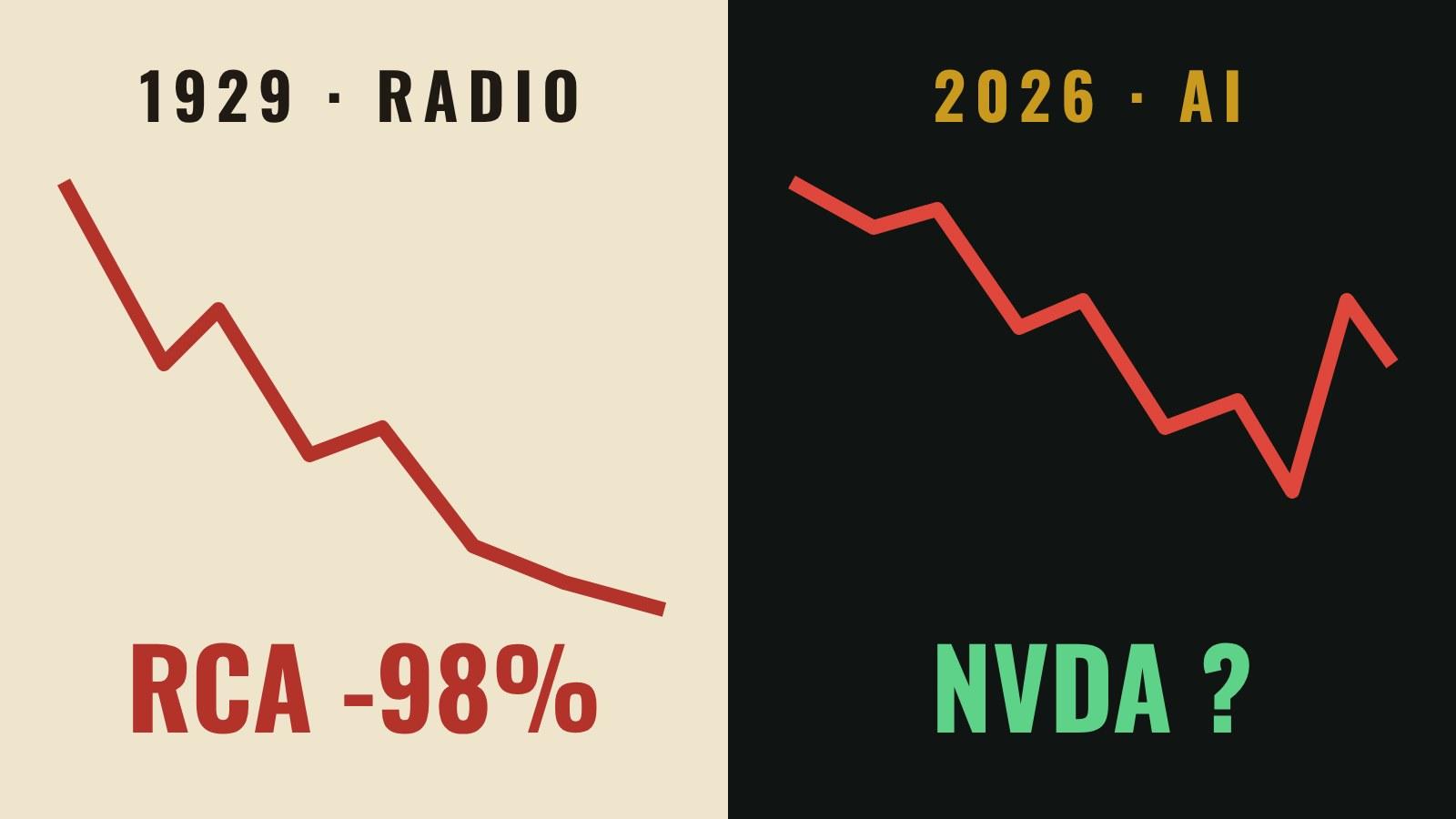
- Nvidia closed at a record $239.24 on Oct 6, 2026. By the Nov 20 close it was about 47.5% lower.
- On Nov 20 the S&P 500 closed in correction territory, 11.6% below its own Oct 6 record.
- Jensen Huang resigned as Nvidia's CEO on Nov 12, 2026. CFO Colette Kress became interim CEO.
- On Nov 23 the board unanimously reinstated Huang. Nvidia rose about 31.5% that day, its best day since 2003, adding roughly $950 billion in market value.
- RCA, the hot tech stock of the 1920s, peaked at $114.75 (split-adjusted) in September 1929 and fell to $2.50 by May 1932, a drop of about 98%.
1 · Eleven days
On November 12, 2026, Nvidia's board announced that Jensen Huang, who co-founded the company and ran it for 33 years, had stepped down as president and CEO, effective immediately. Chief financial officer Colette Kress was named interim CEO while the board searched for a permanent replacement.
Nvidia's announcement didn't give a reason. News reports tied his exit to reports of an extramarital affair and an internal investigation that followed. Shares fell hard that day.
Eleven days later, on Monday, November 23, the board changed course. It said it had voted unanimously to reinstate Huang as president and CEO, after meetings with him and input from senior levels of the U.S. government. Kress went back to being CFO. President Trump told CNBC he was personally involved.
The stock closed up about 31.5% at $165.05, its best day since 2003. CNN put the gain in market value at about $952 billion, in a single session.
A CEO resigned and un-resigned in eleven days, and the market added almost a trillion dollars on the news.
2 · The slide that came first
The comeback rally started from a deep hole. Nvidia's record close was $239.24 on October 6, 2026. By the close on November 20, the stock was about 47.5% below that, close to half its value gone in six weeks.
It wasn't only Nvidia. On November 5 the S&P 500 fell 4.4%, its worst day since April 2025, and the Nasdaq dropped 5.5%, with chipmakers and data-center stocks leading the way down. By November 20 the S&P 500 had closed in correction territory, 11.6% below its own October 6 record.
The reasons reporters gave were a mix: doubts that the huge spending on AI chips and data centers will pay off soon, new tariff worries, and a Fed that is raising rates again.
3 · The rally didn't hold
The day after the comeback, Tuesday, November 24, Nvidia fell more than 5%. On Wednesday the Nasdaq dropped 3.8% as worries about AI spending, inflation and debt came back.
So the big one-day jump got the stock back to where it was a week earlier, not to where it was in October. Reports in the last week of November still had it roughly 35% to 38% below its record, depending on the day.
4 · When the hot tech was radio
In the 1920s, radio was the new technology everyone wanted a piece of, and the Radio Corporation of America was the stock that stood for it. RCA's shares climbed so fast through the decade that it became one of the great market stories of the Roaring Twenties.
RCA split its stock 5 for 1 in March 1929. Adjusted for that split, the shares peaked at $114.75 in September 1929, weeks before the crash. By May 1932 they were down to $2.50, a fall of about 98%.
Radio itself didn't fail. Americans kept buying sets, and RCA went on to build NBC and later push television. The stock was the problem: investors had paid for decades of growth up front. RCA's share price, adjusted for dividends, didn't get back to its 1929 level until the 1960s.
5 · What's the same, and what isn't
The parallel has limits. In 1929 a lot of stock was bought with borrowed money, and when banks called in those loans, sellers had no choice. There was no Securities and Exchange Commission, no deposit insurance and a Federal Reserve that tightened instead of helping. RCA's 98% fall came alongside the Great Depression.
Nvidia, unlike RCA in 1929, reports its results every quarter under SEC rules, and it was still posting very large sales when the slide started. What the two share is the pattern of a new technology that's real, and a stock price that may have run ahead of it.
6 · So why the whiplash? Two guesses
Maybe investors were already nervous about AI spending, and the CEO news simply gave them a reason to sell all at once. A company that's priced as if one person holds the plan is a company that drops when that person walks out.
Maybe the 31% day said less about Nvidia's future than about how crowded the trade had become, with traders who had bet on more losses rushing to buy back in. This is just speculation; nobody can see inside every order.
So is this a dip, or 1929?
This is a fast-moving story. Prices and figures are as of the Nov 25 to 27, 2026 news reports listed in the sources, and some outlets report slightly different numbers. It's history, not investment advice.
Sources
Every fact in this story was checked against these sources on Nov 28, 2026. Lines that start with "maybe" are just our own guesses.
- CFO Colette Kress to serve as interim leader after Nvidia CEO Jensen Huang resignation, CNN (Nov 12, 2026)
- Nvidia CEO Jensen Huang resigns: Live updates, CNBC (Nov 12, 2026)
- Why did Nvidia CEO Jensen Huang resign, and who is Colette Kress?, Al Jazeera (Nov 12, 2026)
- Nvidia Form 8-K: board reinstates Jensen Huang (Nov 23, 2026), U.S. Securities and Exchange Commission
- Nvidia shares soar 30% after board reinstates Jensen Huang, CNN (Nov 23, 2026)
- Nvidia Stock Has Its Best Day Since 2003 as Huang Returns, Benzinga (Nov 2026)
- Nvidia stock continues to fall after massive rally, Jensen Huang apologizes to employees, Yahoo Finance (Nov 2026)
- Nvidia shares fall more than 5% as Huang comeback rally cools, CNBC (Nov 24, 2026)
- Tech stocks are volatile as AI fears overshadow Huang's Nvidia return, CNN (Nov 25, 2026)
- Why Is Nvidia Stock Down? NVDA Falls for a Seventh Week, Admiral Markets (Nov 2026)
- Nvidia Is 37.6% Below Its Record. Trim Or Hold?, Trefis (Nov 26, 2026)
- S&P 500 drops 4.4% in worst day since 2025 as AI chips slide, Associated Press via Spectrum News (Nov 5, 2026)
- AI Bubble Burst Is The Headline, But Not In The Fundamentals, RIA (Nov 2026)
- RCA and the Roaring Twenties, Global Financial Data
- Bubbles and Crashes, chapter 1 excerpt, Stanford University Press
How we make our stories: researched and fact-checked by CoinNCountry, with AI tools helping with drafting, art and narration. More about our process.