Hand Over Your Gold! The 1933 order that made Americans sell theirs, then raised the price
First the government told people to bring in their gold at $20.67 an ounce. Then it marked the price up to $35. Gold bars stayed off-limits for most Americans for more than 40 years.
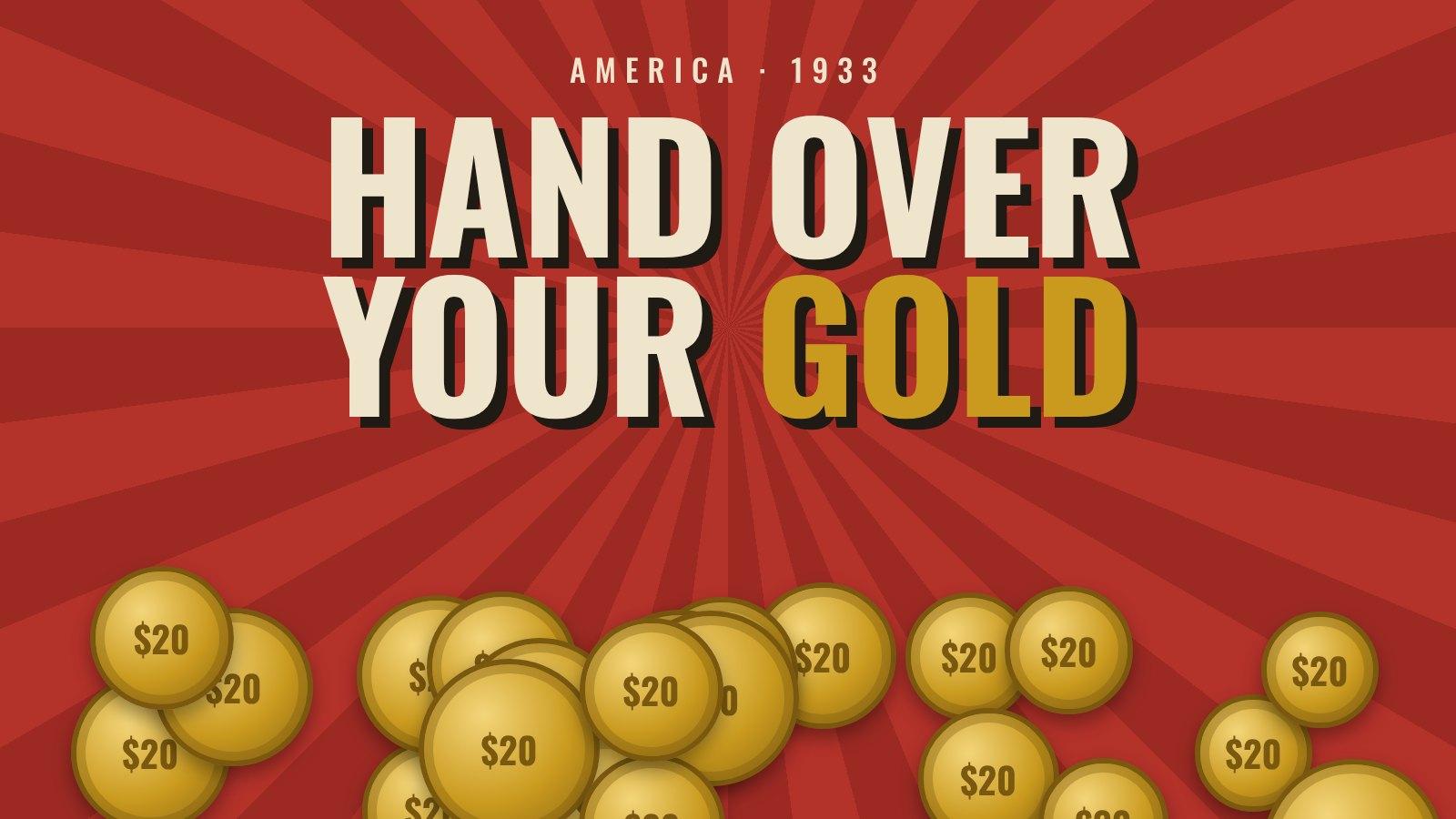
- Executive Order 6102, signed April 5, 1933, required people to deliver gold coin, gold bullion and gold certificates to a Federal Reserve bank by May 1, 1933.
- People were paid $20.67 an ounce, the official price set by the Gold Act of 1900.
- Each person could keep up to $100 in gold coin and gold certificates. Rare coins for collectors and gold used in industry, a profession or art were also exempt.
- Willful violators faced a fine of up to $10,000, up to ten years in prison, or both.
- The Gold Reserve Act, signed January 30, 1934, moved monetary gold to the Treasury, and the official price became $35 an ounce, about 69% higher.
- Americans could legally own gold bullion again on December 31, 1974.
1 · A run on gold
Franklin Roosevelt took office on March 4, 1933, in the middle of a banking panic. Banks were failing, and people who didn't trust them were pulling out gold and keeping it at home. In early March the Federal Reserve Bank of New York could no longer keep its promise to swap paper money for gold, and Roosevelt shut every bank in the country for a national banking holiday.
Gold mattered for a plain reason. By law, the Federal Reserve had to hold gold equal to 40 percent of the paper currency it issued. Every coin that went into a mattress or a coffee can was gold the Fed couldn't count, and by the late 1920s it was already close to the limit of what its gold could back.
2 · The order
On April 5, 1933, Roosevelt signed Executive Order 6102, titled "Forbidding the Hoarding of Gold Coin, Gold Bullion and Gold Certificates." Everyone holding gold coins, gold bars or gold certificates had to deliver them to a Federal Reserve bank, or to a member bank, by May 1, 1933. In return they got other U.S. money at the official rate of $20.67 an ounce.
There were exceptions. Each person could keep up to $100 in gold coin and gold certificates. Gold coins with a recognized special value to collectors of rare and unusual coins were exempt, and so was gold needed for legitimate use in industry, a profession or art, such as a jeweler's stock.
Everyone else who willfully broke the order faced a fine of up to $10,000, up to ten years in prison, or both. The penalties came from the Trading with the Enemy Act of 1917, as amended by the Emergency Banking Act passed that March.
Bring it in at $20.67. Watch it get marked up to $35.
3 · The markup
On January 30, 1934, Roosevelt signed the Gold Reserve Act. It moved ownership of the country's monetary gold, including the gold held by the Federal Reserve, to the U.S. Treasury. The official price of gold was then set at $35 an ounce.
That one change made the government's gold worth about 69 percent more in dollars than it had been a year earlier, when people were handing it in at $20.67. Put another way, the dollar was now worth only about 59 percent of its old value in gold. The Treasury used the gain from the new price to set up the Exchange Stabilization Fund, which the same law created.
4 · The coins that were melted
The Philadelphia Mint had already struck 445,500 of the new 1933 double eagles, the $20 gold coin, but they were never released. Almost all of them were melted down. A handful slipped out of the Mint anyway.
One of them is believed to have belonged to King Farouk of Egypt. After a long legal fight, a settlement with the government made that coin the only 1933 double eagle the U.S. government allows a private person to own. The government auctioned it in 2002 for $7,590,020, and in June 2021 Sotheby's sold it again for $18.9 million, a record for a single coin.
5 · Legal again
The rules stayed in place for decades. In August 1974, President Gerald Ford signed Public Law 93-373, which let Americans buy, hold and sell gold again starting no later than December 31, 1974. On that day Ford signed Executive Order 11825, and gold bars were legal for ordinary Americans for the first time in about 41 years.
All dollar amounts are nominal, in the dollars of their own year.
Sources
Every fact in this story was checked against these sources on Nov 28, 2026. Lines that start with "maybe" are just our own guesses.
- Executive Order 6102: Forbidding the Hoarding of Gold Coin, Gold Bullion and Gold Certificates, The American Presidency Project, UC Santa Barbara
- Executive Order Forbidding the Hoarding of Gold (Circular 1204), Federal Reserve Bank of New York via FRASER, St. Louis Fed
- Roosevelt's Gold Program, Federal Reserve History
- Gold Reserve Act of 1934, Federal Reserve History
- Gold Reserve Act, Wikipedia
- Executive Order 6102, Wikipedia
- White House press release, December 31, 1974 (gold ownership), Gerald R. Ford Presidential Library
- President Ford unlocks access, World Gold Council
- 1933 Double Eagle Sells for $18.9 Million, Setting World Record, Smithsonian Magazine (Jun 2021)
- Auction of rare 1933 double eagle gold coin nets $3 million-plus for U.S. government, United States Mint (Aug 2, 2002)
- 1933 double eagle, Wikipedia
- American Eagle Gold Bullion Coins, United States Mint
How we make our stories: researched and fact-checked by CoinNCountry, with AI tools helping with drafting, art and narration. More about our process.