He Invented Blue Jeans but Couldn't Afford $68. That's Why They're Levi's
A Reno tailor had the idea, a San Francisco cloth seller had the cash, and the name on the label went to the man who paid the fee.
- Jacob Davis, born Jacob Youphes in Riga in 1831, was a tailor in Reno, Nevada.
- In December 1870 a customer asked him for strong work pants for her husband, a woodcutter. Davis fastened the pocket corners with copper rivets he used on horse blankets.
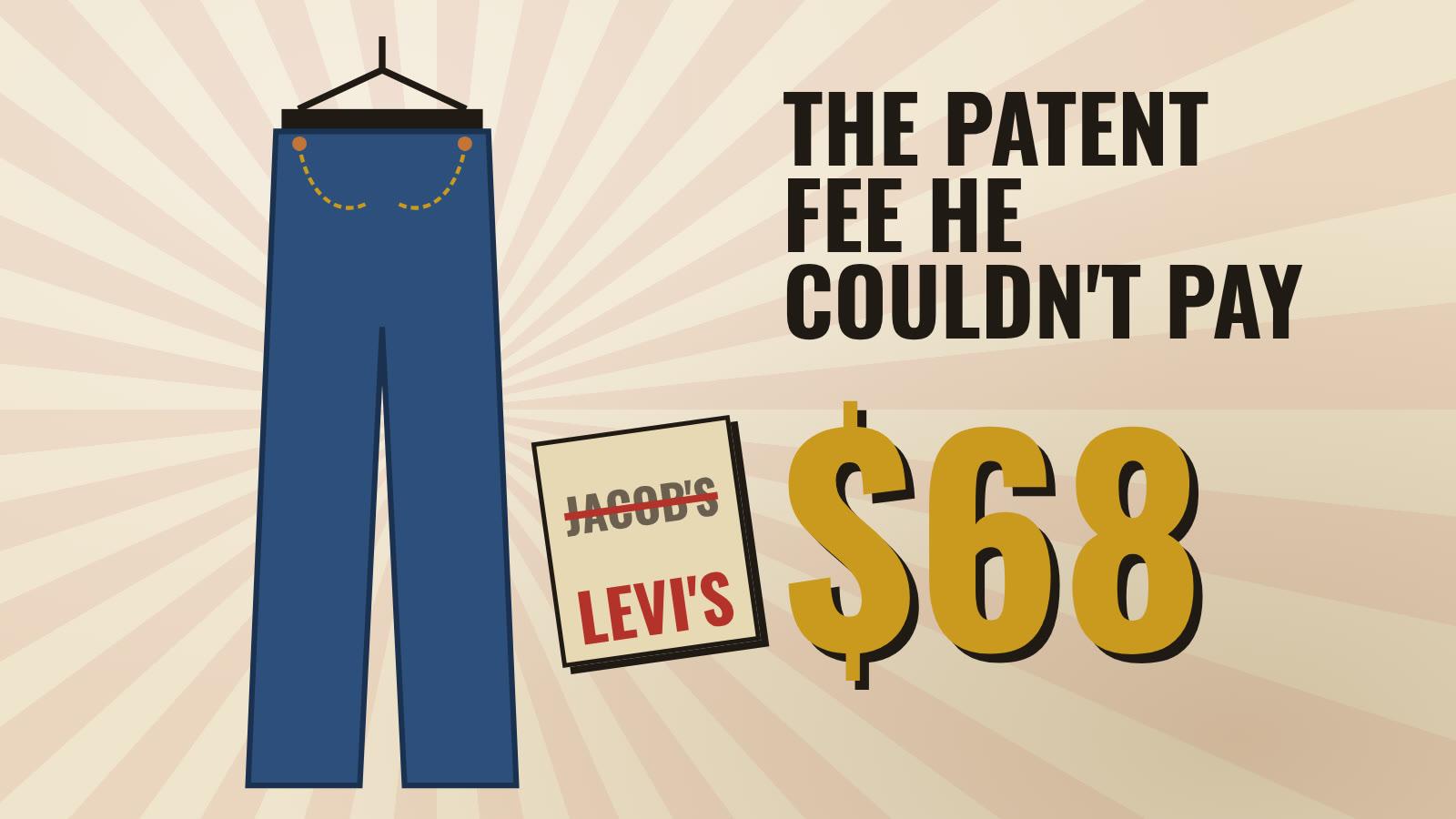
- He couldn't afford the $68 it cost to file for a patent, so in 1872 he wrote to his cloth supplier in San Francisco, Levi Strauss, and offered to share it.
- Patent No. 139,121, "Improvement in Fastening Pocket-Openings," was granted to Davis and Strauss on May 20, 1873.
- The pants were sold as "waist overalls." Levi Strauss & Co. didn't put the word jeans on its labels and ads until 1960.
1 · The woodcutter's pants
Jacob Davis was born Jacob Youphes in Riga in 1831. He came to America in 1854, took the name Davis, and after years of moving around the West he ended up in Reno, Nevada, a young railroad town, running a tailor shop on Virginia Street.
In December 1870 a woman came in with an order. Her husband was a woodcutter, and she wanted work pants for him that would hold up. Davis had copper rivets on hand from his other line of work, making horse blankets. When the pants were done, he hammered rivets into the corners of the pockets, where work pants always tore first.
It worked. Word got around Reno, and soon he was selling riveted pants as fast as he could sew them.
2 · The $68 he didn't have
Davis knew a good idea could be copied, so he wanted a patent. Filing for one cost $68, and he didn't have it. Several accounts say his wife wasn't keen on spending more money on his inventions either.
So in 1872 he wrote to the company that sold him his cloth, Levi Strauss & Co., a dry goods wholesaler in San Francisco. His offer was simple. If Levi Strauss would pay for the patent, the two of them would hold it together.
One man had the idea. The other had $68. The label went to the one with the $68.
Strauss said yes and paid the fees.
3 · Patent No. 139,121
On May 20, 1873, the U.S. Patent Office granted patent No. 139,121 to Jacob W. Davis and Levi Strauss for an "Improvement in Fastening Pocket-Openings." The National Archives still holds the drawing: a plain pair of pants with the rivets marked at the pocket corners.
Levi Strauss & Co. calls that day the birthday of blue jeans. Davis moved to San Francisco to run production for the company, and the first riveted pants came in two fabrics, a brown cotton duck and a blue denim. The Smithsonian has a pair of the brown ones.
4 · Nobody called them jeans
For most of their history, these weren't jeans. They were "waist overalls," work pants that men pulled on over their regular clothes.
The patent only lasted so long. Around 1890 it went into the public domain, and anyone could rivet a pocket. To stand out, Levi Strauss & Co. started giving its products lot numbers. The copper-riveted waist overalls became lot 501. The company's own archive says nobody knows why it picked that number.
The word jeans came from the customers. Teenagers in the 1950s were already using it, and in 1960 the company gave in and swapped overalls for jeans on its labels and ads.
5 · The story that isn't true
You may have heard a different version: Levi Strauss arrives in the Gold Rush with a roll of tent canvas, sees miners in torn pants, and sews them trousers from his canvas. It's a great story. The company's own historian, Tracey Panek, calls it a tall tale that the company itself spread for years, helped along by a TV episode of Death Valley Days.
Part of the problem is that almost all of the company's early records, inventory and photos burned in the San Francisco earthquake and fire of 1906. What survives is the patent, and the patent says the rivet idea came from a tailor in Reno.
Davis did fine. He ran the company's production for years and later sold his share of the patent to Levi Strauss & Co. Strauss got the name on the label. Maybe that $68 was the best deal Levi Strauss ever made.
Sources give December 1870 or 1871 for the woodcutter's order. This story goes with 1870, the date Levi Strauss & Co. uses.
Sources
Every fact in this story was checked against these sources on Nov 28, 2026. Lines that start with "maybe" are just our own guesses.
- Patent Drawing for J. W. Davis's Fastening Pocket-Openings, National Archives, DocsTeach
- Forever in Blue Jeans... and in Court, National Archives, Prologue blog
- Levi Strauss and Jacob Davis receive patent for blue jeans, History.com
- Levi Strauss, PBS, They Made America
- Jacob Davis: 6 Things You (Probably) Didn't Know About the Inventor of the Blue Jean, Levi Strauss & Co.
- Jacob Davis: His Life and Contributions, Levi Strauss & Co.
- The History of Denim, Levi Strauss & Co.
- History of Levi's 501 Jeans, Levi Strauss & Co.
- Truth and Exaggerations of LS&Co., Levi Strauss & Co.
- Levi's Brown Duck Trousers, Smithsonian, National Museum of American History
- Durable and enduring, blue jeans turn 150, NPR
- Nevada's connection to Levi's examined, Northern Nevada Business Weekly
- The Genes of Our Jeans, Nevada Magazine
How we make our stories: researched and fact-checked by CoinNCountry, with AI tools helping with drafting, art and narration. More about our process.