The Fed Did a U-Turn! From rate cuts to hikes, and the last time it went all the way
Twelve months ago the Fed was cutting. Now it's hiking, and markets expect another one on December 9. The last time the Fed refused to blink, people mailed it lumber.
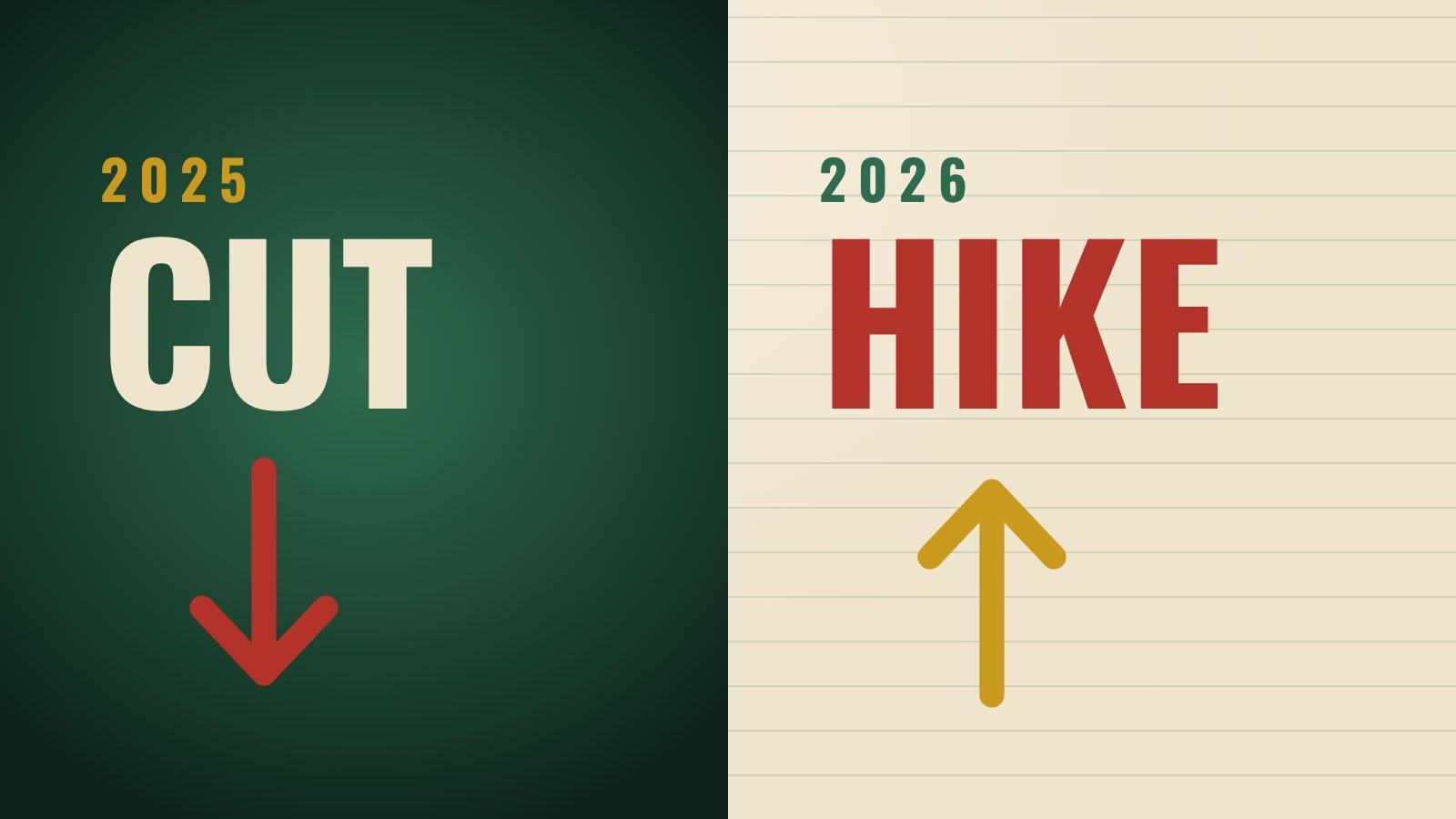
- The Fed cut rates in September, October and December 2025, ending the year at 3.50% to 3.75%.
- On Sept 16, 2026, it raised its target range a quarter point to 3.75% to 4.00%, its first hike since 2023. The vote was 12 to 0.
- October's PCE inflation, the Fed's favorite gauge, came in at 3.8%, with core at 3.3%. The Fed's target is 2%.
- As of late November 2026, markets put the odds of another quarter-point hike on Dec 9 above 90%.
- In 1981, under Paul Volcker, the federal funds rate averaged about 19% for a month and briefly topped 20%. Mortgage rates hit 18.63%.
1 · From cuts to hikes in nine months
In December 2025, the Federal Reserve cut interest rates for the third meeting in a row. Its target range fell to 3.50% to 3.75%, and the Fed's own projections pointed to one more cut in 2026.
That cut never came. On September 16, 2026, the Fed went the other way and raised its target range a quarter point, to 3.75% to 4.00%. It was the first hike since 2023, and not one member of the committee voted against it.
Inflation is the reason the Fed gives. On November 25, the government reported that October's PCE price index, the gauge the Fed watches most closely, was up 3.8% from a year earlier. Core PCE, which leaves out food and energy, was 3.3%. The Fed aims for 2%.
The next decision lands on December 9. Traders in futures and prediction markets put the odds of another quarter-point hike above 90%, which would lift the range to 4.00% to 4.25%. Fed Governor Christopher Waller has even raised the idea of a half-point move.
A year ago the question was how fast rates would fall. Now it's how high they'll go.
2 · Case one: Volcker's Saturday night
To see a Fed that truly refused to blink, go back to 1979. Inflation had been climbing for a decade. Paul Volcker took over as Fed chair on August 6, 1979, picked by President Jimmy Carter.
Two months later, on Saturday, October 6, Volcker called a rare evening press conference. The Fed would stop steering by interest rates and start limiting the growth of the money supply instead, and let rates go wherever that took them.
Rates went up. A lot. Consumer prices were rising 14.8% a year by March 1980, the peak of the era. By 1981 the federal funds rate averaged about 19% for a month and briefly topped 20% on single days. The prime rate banks charged their best customers hit 21.5%, and in October 1981 the average 30-year mortgage reached 18.63%.
3 · Two-by-fours in the mail
Americans let the Fed know how they felt. Homebuilders, with almost nobody able to afford a mortgage, mailed the Fed pieces of two-by-fours. Volcker later described them as sawed-off chunks of lumber with angry messages written on them. Car dealers stuck with unsold cars mailed in keys. Farmers drowning in loans drove their tractors to Washington and blockaded the Fed's headquarters.
The pain was real. A recession ran from July 1981 to November 1982, and unemployment peaked at 10.8% at the end of 1982, the highest since the Great Depression at the time.
But inflation broke. By 1983 it was down to about 3.2%. Volcker stayed on as chair until 1987, and mortgage rates, while still high, never went back to their 1981 peak.
4 · Case two: the 1994 surprise
Not every hiking cycle ends in a recession. In February 1994, with inflation still fairly tame, Alan Greenspan's Fed raised its target from 3% to 3.25%, its first hike in five years. Then it kept going.
By February 1995 the rate had roughly doubled, to 6%. Bond investors hadn't seen it coming. Yields jumped, bond prices fell hard, and Fortune magazine called it the Great Bond Massacre.
The economy, though, kept growing. The 1994 hikes are usually remembered as the rare soft landing: the Fed got ahead of inflation without tipping the country into a recession.
5 · How today stacks up
Today's numbers are nowhere near Volcker's. What the two moments share is the direction: a Fed that had been easing decides inflation is the bigger threat and starts climbing again. Whether 2026 looks more like 1994, a short run of hikes and a soft landing, or something longer, depends on numbers nobody has seen yet.
6 · So why the flip? Two guesses
The Fed says inflation, and the data back that up. Why inflation came back is less settled, so this part is just speculation.
Maybe it's tariffs. When the Fed cut in December 2025, it blamed much of its inflation overshoot on tariffs, and new tariffs on 14 trading partners were proposed this week. Higher import prices can take months to show up in the gauges.
Maybe the economy is simply running hot. Third-quarter growth was revised up to 4.3% this week. A fast-growing economy with prices still rising is exactly the mix that makes a central bank reach for higher rates.
This is a fast-moving story. Rates, odds and inflation figures are as of Nov 28, 2026, before the Fed's Dec 9 decision. It's history, not investment advice.
Sources
Every fact in this story was checked against these sources on Nov 28, 2026. Lines that start with "maybe" are just our own guesses.
- Implementation Note issued September 16, 2026, Federal Reserve Board (Sept 16, 2026)
- Minutes of the Federal Open Market Committee, September 15-16, 2026, Federal Reserve Board
- Fed Rate Decision September 2026: Benchmark Hiked to 3.75%-4.00%, Raisin (Sept 16, 2026)
- Fed cuts interest rates for third straight time amid uncertainty over labor market, inflation, Fox Business (Dec 10, 2025)
- Fed Cuts Rates With Three Dissents, Projects One Cut in 2026, Bloomberg Law (Dec 10, 2025)
- PCE inflation gauge still running hot, as December rate hike looms, InvestmentNews (Nov 25, 2026)
- US PCE rises 3.8% in October: experts say Fed rate hike in December a done deal, Invezz (Nov 25, 2026)
- Fed Set to Raise Interest Rates Next Month as Debate Moves to January, Bloomberg (Nov 13, 2026)
- Fed Meeting December 2026: Interest Rate Decision Odds, Kalshi (Nov 2026)
- U.S. proposes new tariffs on 14 trading partners, including China and the EU, CNBC (Nov 25, 2026)
- Volcker's Announcement of Anti-Inflation Measures, Federal Reserve History
- Paul A. Volcker, Federal Reserve History
- One hundred years of price change: the Consumer Price Index and the American inflation experience, U.S. Bureau of Labor Statistics, Monthly Labor Review (April 2014)
- Former Federal Reserve chairman Paul Volcker dies at age 92, PBS NewsHour (Dec 9, 2019)
- The 1979 Volcker Shock: forced disinflation, eco3min
- Mortgage Rate History, 1971 to 2026: 18.63% High, 2.65% Low, MortgageRatesToday (Freddie Mac data)
- Risk Management in Monetary Policymaking: The 1994-95 FOMC Tightening Episode, Federal Reserve Bank of St. Louis Review (April 2025)
- The Great Bond Massacre, Fortune (1994)
How we make our stories: researched and fact-checked by CoinNCountry, with AI tools helping with drafting, art and narration. More about our process.